amazon-affiliate-banner1

Tuesday, 18 September 2012

NATUROPATHY- NATURE CURE HOSPITAL


chitrannaa.blogspot.in
UJIRE-DHARMASTHALA-SOUTH CANARA-KARNATAKA- INDIA

This is an in depth analysis and guide for the Nature cure hospital at Shantivana - Ujire - Dharmasthala - Karnataka - India.                       

  
Dhanyosmi! This was the overwhelming feeling I had about the noble souls who had envisioned and started this Nature Care Hospital for a holistic treatment. They had a vision, a noble cause and a yearning to serve and guide the society towards a healthy living.

I had first heard about the nature care hospital at        Dharmasthala way back  may be in 2006-2007 when my friend Sujatha from Tumkur, who had been there for treatment narrated her wonderful experiences. She was all praises for the service oriented treatment meted out there. It had always remained at the back of my mind that I should visit the place. In fact just a month back when we programmer friends at the monthly meet were sharing our health and stress woes, we were sort of planning that at least once we should skip this daily mundane and escape to Dharmasthala. I, in my wildest dreams, would not have imagined that exactly one month later when all my colleagues were attending the meeting, I would be here in Dharmasthala indulging in a holistic treatment for the body and soul.  

Yes. That is what it is. I think there is a wrong notion that one should visit this place only when one has health issues or obesity problems. Contrary to this I feel that once one reaches 40, it is a place one must visit ( But of course, there is always heavy demand and one has to book the rooms very well in advance and generally, very healthy persons are not solicited, as they want to address the problems of the patients first.)

The accommodation in Ujire has been made to suits to all pockets and budgets. There is a general ward for Rs.300 per person per day, a special room at Rs.450 per day on twin sharing, Deluxe rooms on twin sharing at Rs.700 per day which has TV and AC. Then there are cottages which cost Rs.1250 per day per person,wherein the  occupants  have the advantage of having some of the massages and food in their rooms. The rent includes the room rent and food charges.For additional treatments they charge a nominal fee which works out to approximately Rs.1000 for a stay of ten days, with two treatments per day.If one needs further treatments like acupuncture, physiotherapy, then it costs about another 50 rupees per day.    

The procedure of admission is quite simple. The rooms can be booked over phone, but well in advance. Immediately on arrival, an in-house doctor will check us,   prescribe further clinical tests needed, if any, gives us a diet scheme depending on our body constitution and health problems. These notes will be recorded on a  card which will be updated everyday by the doctor visiting us. We are supposed to carry this card  for all our treatments, juices and foods.  


Well, talking about food, this could prove the ultimate boon or bane for our stay. Here is the real catch. Those who have a strong will power and self-control over their food habits need not worry. For weak minded, or those who love food        ( then, who would not!? ) this is a strict no-no. We are not supposed to carry any eatables from home. At the entrance gate itself the security will whisk us and take away any eatables found on us. Once we enter inside, other than the food provided by the staff, we will  get ABSOLUTELY NOTHING. Forget tea or coffee, even milk is out of our reach. But if you have some funny bones, you will thoroughly enjoy the sights there at the dining area! 

It will be a sight to watch how people used to indulge in sumptuous meals looking longingly at a hot chapati or a person weighing more than 100 kgs holding his cup of papaya gingerly and take half an hour to eat it or the girls who are officers back home in their towns, but are on juice diet at the centre pouncing on the plates of persons who are allowed rice. 

There are  three varieties of diet foods provided here :  boiled diet, raw diet, and juice. The taste every day for every food remains just the same ( In fact I always wondered how could they prepare it exactly the same way everyday. If you have tasted it for one day, then you have tasted it for all days! ) The boiled diet consists of rice boiled with a little green gram dal, a few vegetables and just a hint of salt and pepper. A few boiled vegetables, which would be cucumber, ash gourd or sorekai – thats it!  - again with a hint of salt and pepper.
You have a choice of soup or buttermilk. Hello don't jump with joy. Soup means the vegetable stock of the above mentioned vegetables and buttermilk without salt or sugar ! Plus a cup of papaya or one apple.
                  

The evening food will be the same type of vegetables with two dry chapatis instead of rice and everything else will remain the same. For raw diet, it is a salad of cucumber or carrot – I would rather not use the word salad because except the cut vegetables, it has no other ingredients – and on occasional lucky days you will find finely chopped apple or pineapple in it. No salt or khara ! And if the doctor thinks that it will be more food for you, they may just prescribe one apple or one cup papaya along with buttermilk or soup. Mind you, if you feel instead of buttermilk let me take soup – sorry madam, you have to get doctor's permission – who will be available in the dining hall - before taking the plate. Once you cross that point, even if you beg, it cannot be changed. Sorry.
And for those less fortunate souls, who are overweight,it is a glass of juice four times a day ! Don't feel so sad, at dinner and lunch time, they will 
keep the juice made from lime and honey and you can have an extra cup or two! Other than that if you complain of tiredness you are advised to drink lots of water. Don't worry, you will get used to it and in extreme situations, doctors are there round the clock to take care !


The food picture looks extremely bleak – is it ?  No that is not the case. If you feel you will not be able to sustain or feel weak, you can approach the doctor      next day who will switch over the diet from raw to boiled or increase the number of chapatis or fruits. But then forget about the weight loss ! But for the fortunate few who need not worry about the weight, there is a choice of ragi ganji at 9 am. and sprouts with cucumber slices at 4 pm, plus a cup of milk at 9 pm. BUT FORGET ABOUT THE TASTE, SALT AND SUGAR AND SPICES! It is the principle of the hospital that not only should you eat SATWIK food, but control your craving for food too.

The daily routine is : getting up at 5 in the morning, go for a walk, yoga and pranayama  from 5.30 to 7 A.M. At 7.30, it is juice – whichever the doctor has prescribed for you , it may be line and honey, carrot, ash gourd or bitter gourd.  Then back to rooms where everybody will sleep for a mud pack on their eyes and tummy for about 20 minutes. Immediately after, rush with your card to the treatment area where you will be given the treatment which your doctor has prescribed for you. 


These treatments any day beat the best of spas' treatment. It includes a variety of water treatment like hip bath, spinal bath, cold or neutral water immersion bath, jet bath, whirlpool.... There are still many more. Or steam bath, sauna, reclining steam bath, oil massage, mud bath, haldi pack... you name it and they have it. Essentially it is back to nature - an idea of treating us with five elements earth, wind, water, fire and the sky. I must never forget the attitude of the staff involved in the treatments. They always have a smile on their lips and a spring in their feet. They are virtuous  to a fault.

Each treatment is given with such a sincerity and dedication that you will feel like you are in the lap of your mother when the personnel share your pain with a sympathetic understanding and rejoice at your relief. 


We were fortunate to be at this place on 15 th August and in the serene atmosphere on a bright and sunny morning we witnessed the flag hoisting and sang the National Anthem with a pride. After the ceremony we were no less than the school children when trays filled with some covers arrived at the venue. There was excitement all around and murmurs of laddoos, chocolates, sweets filled the air. You should have seen the face of all the recipients when they opened the covers and found that there were two dry dates and two tiny pieces of rock sugar in it! What a healthy way of celebration! 
chitrannaa.blogspot.in

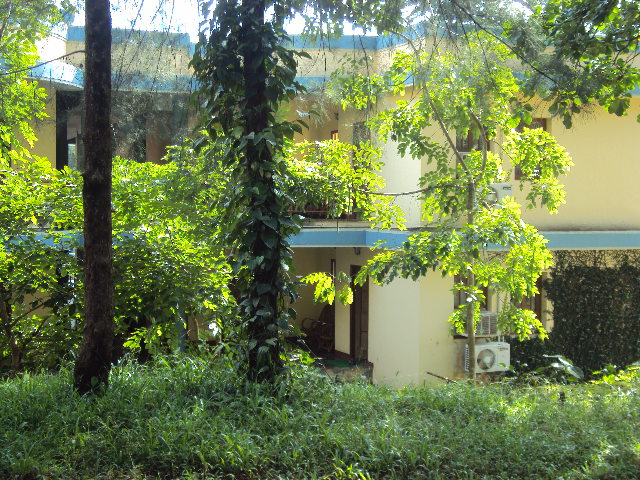
Though the entire building is spread over a vast area, a french architect has designed it so well that from every room, hall and window you can view a garden and rain.
If this is the photo of our bathroom window you can very well imagine how the entire building is built. The rooms, treatment and yoga centre are all a midst greens and gardens and throughout your walk from one end to the other, there is proper shelter so that no rain or sun can dampen or hamper your spirits. 

There is a swimming pool, a gym,a hillock to walk and indoor games and library. But library and TV will be available only at free or rest time so that nobody misses the treatments or sessions. The yoga and pranayama are taught with utmost proficiency and personal care. 

There is a personalised treatment and care for every inmate and on the last day we would be given a follow up chart and advice for our treatment and diet back home. That day, we will be given passes to visit Sri Manjunatheshwara Temple which entitles us a direct entry to the sanctum sanctorum.


I have a greatest sense of gratitude towards Dharmadhikari Sri Veerendra Hegde, The Man behind this noble venture and when I had the fortune of meeting him at Dharmasthala, I made an humble request to him to start one such unit in our very own Bangalore. My joy knew no bounds when he informed me that the land has already been purchased on Tumkur road in Bangalore and the treatment centre may come up there soon.Amen!


Sunday, 2 September 2012

holige recipe | obbattu recipe | bele obbattu | puran poli karnataka style recipe


chitrannaa.blogspot.com

The Gowri festival  is fast approaching and THE sweet for this festival, of course, is obbattu. I had been following up with my mother,  many of my friends and relatives, and there are as many recipes. And there has always been that confusion over maida or atta, kadle bele or togari bele and akki hittu or kadle kai enne. Now I got the perfect recipe from my friend Padmaja, who over several experiments had arrived at the perfect, healthy and tasty recipe of obbattu. The method is simple and moreover if you have a sweet tooth, you can prepare and keep the hoorana ready in the fridge and make obbattu at a very short notice too. I tried it today and the result was mind blowing. Sure you would love to prepare it and enjoy!

Ingredients :


Maida                                            2  cups
Atta                                              1  cup
Turmeric  powder                           1  tablespoon
Salt                                               1  teaspoon
Groundnut  oil                                1  big cup                                              
Water to mix                                  1 1/2 cups
Kadale bele  (chana dal)                  2  cup
Togari bele  (Tur dal)                      1  cup
Pounded Jaggery (unde bella)          3  cup
Yalakki (Elaichi) pudi                       1  tablespoon

Method  :


  • Mix maida, atta with a tablespoon groundnut oil, salt and water and knead thoroughly. Set aside for 3-4 hours.
  • Separately cook kadale bele(chana dal) with a lot of water and togari bele(Tur dal) with equal quantity of water. 
  • When cools down drain the excessive water.
  • In a thick bottomed kadai, mix dal and jaggery and cook, stirring continuously while monitoring the heat. 
  • Once it is cooked evenly and all the water is absorbed, mix elaichi powder and let it cool.
  • Once it cools, grind to a nice paste. If you are doing the aloo paratha, you know that the consistency of this should be as of the stuffing.
  • Make little balls of the mix (hoorana) and set aside.  
  • Separately make small balls of the atta, roll into small puris and stuff the hoorana and cover like a paratha. 
  • Do this for all the puris and set aside.
  • Now roll the obbattu on a plantain leaf or holige paper dipping the dough in rice flour. 
  • Cook on a tava putting generous quantity of oil. 
  • Lightly cook on both sides.
  • Serve hot with ghee and milk. 
  • The Best way to eat obbattu according to my grandpa is to put hot milk and ghee in a cup, dip hot obbattu into it and eat. 
  • Forget the calories for a day!


Thursday, 1 March 2012

Recipes for Kids

                                               
chitrannaa.blogspot.in
Here I have given four recipes for your little darlings :
  • One main course - vegetable frankie - which children love and we are happy because they will be eating a variety of healthy vegetables. 
  • One Sweet : Remember, this hesarittu unde is THE BEST brain tonic. Give one to your child everyday and I bet he/she will score 100 in maths. I myself and both my children are proofs of this!  
  • One chat - Masala kadlepuri (puffed rice) - I am sure this is one chat you would love to give to your child and also fight to share.
  • One dessert - Double ka meetha - This deliciously rich dessert used to be  the favorite of  all the Nawabs. I bet you would be tempted to gobble but remember its richness and calories !
                                DOUBLE KA MEETHA


Ingredients :

Saturday, 25 February 2012

BITTER SWEET LIFE

chitrannaa.blogspot.in

We always think that we are living life on our terms, creating and reacting to the situations as we wish and that nothing drastic can happen to us, at least as long as we are careful.How far from truth it can be! He, up there, holds the strings of our lives and decides what should happen and when and pulls the strings and here we will be dancing to His tunes. We, both myself and my husband were quite disciplined in our food habits, exercise régime and were under the impression that we had taken good care of our health.

This myth was shattered one fine(?) day when my husband had unbearable abdominal pain. Of late he had been having it occasionally, which he would diagnose (?) as acidity or gastric conditions and some fasting would solve the problem. But this time the onslaught was so sudden and intense that he started rolling on the floor clutching at his tummy and vomiting in between. It was horrifying to see him in that pathetic condition. When we called his friend Mr.Surendra Hiremath, a dermatologist working at Bangalore Hospital, he asked us to rush to hospital as it appeared to be a case to be referred to a surgeon.
That started it. My husband was taken for x-ray, scanning and other tests and when we were asked to deposit Rs.10000 immediately, we knew that it was going to be a stay for at least 2-3 days. When I called my daughter at home, who was readying the bed for her dad when he returns after the checkup  was full of tears. I assured, albeit falsely that we would be home latest by next day, but ultimately it turned out a long stay of ten days at hospital, during which period my husband was diagnosed as having gallbladder stones, which had inflamed the pancreas. So before removing the gall bladder, the condition of the pancreas had to improve, which took six days, through endoscope the fact that there are no stones in duct had to be ensured, which took another 2 days and finally on 8 th day he was operated upon and we came back home on 10 th day.
But those 10 days had their own funny moments, positive instances, and cherishable memories.
We were both in awe and reassured in the presence of the  gastroenterologist Dr.Praveen, who appeared to be very strict and tough taskmaster but his eyes twinkling through  his glasses would give away his witty humorous nature. When he explained first that gall bladder had to be removed, I asked him what happens next. Straight faced, he replied, “ When you demolish a house, what remains there? A vacant site! That’s what happens here.” Then I asked what if there is unauthorised encroachment, he re-assured that there will be proper fire-wall and fencing and there is no need to worry. But he did warn that burping may continue as long as there is gas in the body, and that he is also having occasional bouts of them, when his wife leaves him but returns after 2-3 days! His best advice was to avoid four types of meals :  marriage, festival, ceremony and griha pravesh and even at home to listen to the lengthy intestine and not two inch tongue ! On another day, after scanning, when I enquired about the size and number of stones, as friends and visitors have been enquiring about  them and I was unaware, he advised “  It is not your bank balance which you need to count or boast of, just ignore it! ”  
After the operation, due to the anesthesia affect, my husband was uttering something inaudible, and though we had trouble in making sense of them, at times we could not control our laughter. As he had been on drips for 8 days, he must have been thinking and dreaming about food and hotels, so once when I asked him if there was any pain, he blurted, ”Dr.Praveen is dancing on a table in Roti Ghar !”

 As it was very important that post operation, all organs take over their respective functions, doctors and nurses were monitoring everything very closely. When I was sitting and chatting with my husband and children on the day after operation, a nurse came and asked my husband whether he could urinate and my husband replied in the affirmative. Already a bemused look was appearing on our children’s  face, then she asked “ How much ? 200ml ”  My husband, a little dismayed, replied “normal”. Then her face cleared as she muttered “oh 300ml . That day we realized the measure of normal urination but could not help giggling when my husband commented “ How do I know? A few drops might have fallen when I get up !”.

 But the best comment came from my children after the operation when they commented that they have learnt so much during those ten days. They together had taken charge of everything: physical, financial and emotional. Before operation even though my son was getting late to work and daughter to her college and their mobile alarm would be ringing, we had to shout several times for them to get up and get ready. Even if one time a day I could not cook their favorite dish, they would fret and fume but here they were, getting up at 5.30, taking care of our pet dog Pogo, managing all the household work  and cooking, taking night shifts at hospital, and still always trying to cheer us up, and insisting that we both eat and sleep properly.

So I realized that it was not what they have learnt during this period - as the life would have given them the responsibility and opportunity to learn things naturally anyway - it was I who have learnt the biggest lesson of my life, that I need not unnecessarily worry and fear about my children’s capacity to learn and manage things but also to adopt to the situations.

 Life is the biggest teacher.
  

Wednesday, 25 January 2012

COOKING - A CREATIVE ART


www.chitrannaa.blogspot.in

Cooking is a creative art.. Like a painting, pottery poetry etc, raw materials go into it and a complete product comes out. While cooking one has to give weightage and importance not only to its taste but to its colors, textures, smell and presentation. It can be enjoyed only if it is taken as a pleasure You will get best results only when your heart is involved in it and you are marveled and derive pleasure while it is being created. In fact cooking and love for it is a gift from God.

Though it  is said that we should eat to live and not vice-e-versa, at the other extreme no man can survive without eating. So it is of great importance as to what, when and how we eat. Fortunately for me my mother was a not only a great cook (whose mother is not ?!) but had instilled a great passion in me for cooking from a very tender age. I used to marvel at most complicated cooking, always taking it as a challenge and trying always to be the best. And by God’s grace, my daughter is continuing this lineage and  in fact challenges me at times. Earlier we used to write recipes in bound books or diaries which originally white in colour would turn to yellow over the years. I even now have preserved my first cookbook though its page have turned brittle because it carries the sweet memories when my late mother dictated the recipes and was in fact very proud of my cooking.

This blog is a gift to my daughter and son who have grown so fond of my cooking that at times they even prefer my cooking to restaurant’s food (only a few, not all !). So that they need not have the botheration of writing and finding the notebook. 

THALIPEETH


chitrannaa.blogspot.in
Ingredients :
Bajra (sajje) or corn flour    1 cup
Rice flour                                       1 cup
Wheat flour                                    1 ½ cups of
Gram flour                                     1 cup
Green vegetables (palak or methi) 250 gm
Ginger                                            1”
Coriander leaves                          ½ bunches
Green chillies                                 7-8
Sugar                                             1 teaspoon
Pepper                                    1 teaspoon
Cumin powder                         1 teaspoon
Turmeric powder                     ½ teaspoon
Asafoetida                                ½ teaspoon
Coconut powder                      1 tablespoon
Onions                                   2
Oil for frying

Salt to taste

Method :


aloo matar recipe | aloo mutter recipe | alu matar recipe


chitrannaa.blogspot.in


Ingredients  :


Potatoes                                       250 gm
Shelled peas                                 250 gm
Big tomato                                   1
Onions                                         2 medium size
Curd                                            ½ cup
Turmeric powder                          ½ teaspoon
Ground cumin seeds                     ½ teaspoon
Garam masala powder                  ½ teaspoon
Ginger piece                                 ½ “
Minced green chillies                     5
Coriander leaves sliced                  – handful
Chilly powder                                1 tablespoon
Salt to taste


Method :


  • Peel and cube potatoes
  • Grind onion and ginger to a paste. 
  • Heat 2 tablespoon ghee and fry the ground paste to a golden colour. 
  • Put in spices and fry briefly. 
  • Put in diced tomatoes and carrots and cook till the ghee separates. 
  • Put in the peas, potatoes and chillies. 
  • Fry for 5 minutes. 
  • Add 1 cup of water, mix well and pressure cook. 
  • Serve hot with rotis and phulka decorated with coriander leaves.

veg makhanwala recipe | vegetable makhanwala | veg makhani recipe


chitrannaa.blogspot.in


Ingredients :


Carrots                          100 grams

Potatoes                        100 grams
Cauliflower                    100 grams
Beans                           100 grams
Capsicum                      100 grams
Tomatoes                      2
Onion                            4
Garlic                            3 cloves
Ginger                           1 small piece
Butter                           1 Tablespoon

Cumin Powder               1 teaspoon

Black cardamom            1
Cinnamon                     3/4 inch
Cloves                          4
Poppy seeds                  1 Teaspoon
Sugar                           1/2 Teaspoon
Tomato Sauce               2 Teaspoon
Fresh Cream                 1 Teaspoon
Salt to taste


Preparation : 


This is a hot, spicy and tasty North Indian curry, with rich tasty gravy that goes very well with phulkas and rotis.

  • Pare and cut into longish pieces  100 gms carrot, 100 gm potato, 100 grams cauliflower. 
  • String and cut in a similar manner 100 gm fresh beans. 
  • Cut 1 or 2 capsicum into longish pieces.
  • Peel and cut 1 large or 2 medium onions in similar way. 
  • Grind to a paste 2 medium onions. 
  • Separately grind 3 cloves garlic and a small piece of ginger, peel and chop 2 large tomatoes.
  • Heat 1 tablespoon butter in a pan. 
  • Fry onions on low heat, till fat separates. 
  • Add garlic and ginger and lightly fry, then add tomatoes, 1 teaspoon cumin powder and salt to taste.
  • Grind to powder 1 black cardamom, 3/4 inch piece cinnamon, 3-4 cloves and 1 teaspoon poppy seeds. 
  • Add to the masala paste.
  • Put in all the vegetables except capsicum, stir fry, cover and cook over low heat, adding a sprinkling of water if necessary. Cook for 10 minutes.
  • Mix in capsicum. Cover and cook further till vegetables are done. 
  • Add 1/2 teaspoon sugar, 1/4 cups water and 2 teaspoon tomato sauce.Stir through till well mixed.
  • Before serving add 1 teaspoon cream or butter. If you don't want a sweetish taste omit the sugar and lessen the quantity of sauce. Makes 6 servings.         

Navratan Korma recipe | (Vegetable Korma) | Mixed veg korma |


chitrannaa.blogspot.in

Ingredients :


Mixed vegetables   2 cups
Onion                   1
Red chillies           5
Garlic                   4 cloves
Pepper seeds        1 teaspoon
Jeera                   1 teaspoon
turmeric               1 teaspoon 
coconut                ¼
jaggery juice        ½ tablespoon ( If you like sweetish taste )
tamarind juice      1 tablespoon
ghee                    2 serving spoon
salt to taste


Method :

  • Pour boiling water over the diced vegetables and add salt, cover and set aside. Slice the onion. 
  • Grind the masala with all the above ingredients excluding onion. 
  • Heat ghee and fry the sliced onions till golden brown. 
  • Add masala and fry. 
  • Add the vegetables and water, cover the pan and pressure cook. 
  • On cooling, simmer gently until the vegetables are tender.
  • Serve with pooris and rotis.


Wednesday, 18 January 2012

PANI PURI

                                       
chitrannaa.blogspot.com
Preparation Time :     30 minutes
Cooking Time :          20 minutes

This is one of the tasty and healthy North Indian snacks like Masala Puri, Tikki Puri and Dahi Puri.


Video link of the recipe here :